

Guide
How long does an electric hot water tank last?
The short answer
An electric hot water tank usually lasts 10 to 15 years depending on the manufacturer, according to CAA-Québec, and Intact Insurance says about 10 years for most hot water tanks. In practice, your insurer often decides first: several ask for replacement after 10 years, others after 12. Check the year on the rating plate, then check your policy.
The part in question
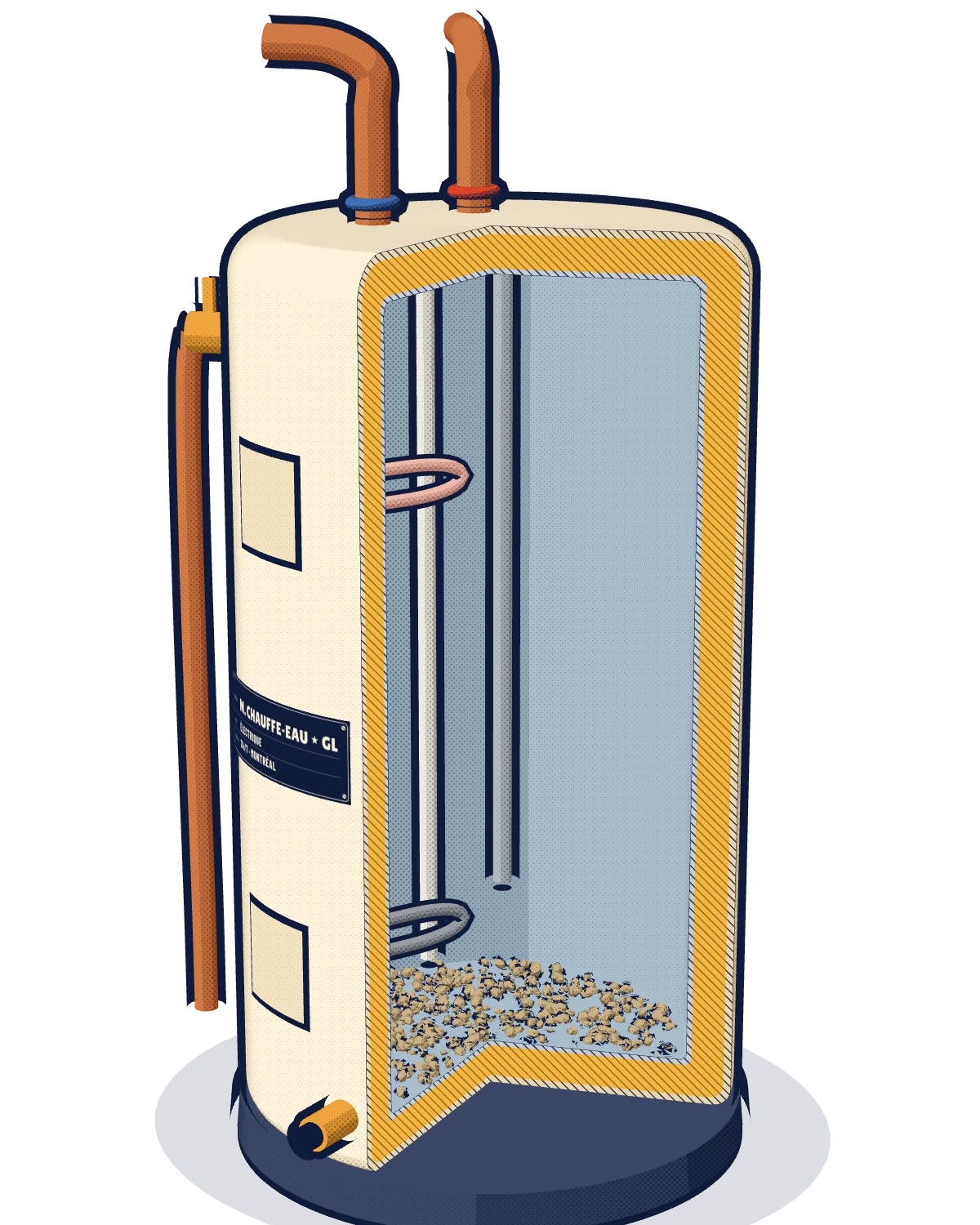 Anode rod
How many years, in practice
The published numbers are close to each other. CAA-Québec says 10 to 15 years depending on the manufacturer. Intact Insurance writes that most hot water tanks last about 10 years, and that the risk of leaks, sediment build-up and major failure rises with age. Hydro-Québec says a three-element ECOPEAK tank lasts about 12 years from the date on its rating plate.
What about a 40 gallon? The sources we checked give no different lifespan for a 40 or a 60 gallon tank. What they do name is the anode, the water and the upkeep, covered below.
Then there's the date that matters to your insurer. According to Radio-Canada's consumer show La facture, several insurers ask you to replace the tank after 10 years, others after 12, even if it works fine. If you don't, the insurer can add a rider to your policy that excludes water damage. The show points out that water damage is the leading cause of home insurance claims in Quebec.
Why does 10 years come up everywhere? On the radio show Moteur de recherche (ICI Première, 2026), the explanation is that insurers set the standard, putting the risk threshold at a decade: after that, the odds of a failure climb sharply. The details are in Hot water tank age and home insurance.
What wears it out (anode, sediment, temperature)
Here is what the manufacturer, CAA-Québec and the Régie du bâtiment du Québec say about what wears a hot water tank down, and what protects it.
The anode
It's the part that sacrifices itself. In a Giant tank, the magnesium anode slowly wears away to protect the glass-lined tank from corrosion. Giant recommends checking it every two years and replacing it once more than 50% of it is gone. Once the anode is used up, corrosion goes after the steel of the tank, Moteur de recherche explains.
Hard water and water softeners
According to CAA-Québec, the anode dissolves slowly in soft water but quickly in hard water, and it is then replaced with an aluminium anode. Giant adds that a water softener also wears anodes faster, because the added salts make the water more conductive.
Sediment at the bottom
Sediment settles at the bottom of the tank. Giant says the build-up reduces the tank's efficiency and its lifespan, and recommends draining about a bucketful once a year. With hard water or well water, scale builds up faster, CAA-Québec notes.
Temperature
Set it to 60°C and leave it there. That's Giant's factory setting for Canadian models, and Hydro-Québec points out there's no reason to heat water any hotter. Turning it down isn't better either: the Régie du bâtiment du Québec requires stored water to stay at 60°C or more, because of the risk of legionella bacteria.
Finding its age
The year of manufacture is on the rating plate, the label on the side of the tank. That's where CAA-Québec tells you to look, and it's from that date that Hydro-Québec counts an ECOPEAK's 12 years.
No year in plain sight? Write down the model number and the serial number: those are the two details Giant asks you to keep for your records. Giant doesn't publish a way to read the year from the serial number. Send us a photo of the plate: we'll tell you how old your tank is.
The easiest way is still a photo of the plate, up close and well lit. We read it for you when you ask for a price.
Signs it's reaching the end
CAA-Québec recommends considering a replacement if you notice:
- water that isn't as hot as it used to be, or runs out faster;
- slightly reddish water;
- rust at the bottom of the tank;
- moisture or drops of water around the tank.
A rotten-egg smell
Not always the end. Giant explains that the magnesium anode can react with sulphur in the water, most often well water. An aluminium anode and a cleaning of the tank can solve it or greatly reduce it.
Noises
Moteur de recherche notes that a hot water tank's smells and noises can give you an idea of its condition. A tank that starts talking deserves a look.
No signs, but 10 years on the plate
A tank can work perfectly and still be past your insurer's limit. According to La facture, some insurers ask for replacement even when the tank works fine. Read your policy.
When to call a professional
Right away, if there's water or rust at the base of the tank: shut off the power at the panel, close the cold water valve and call. The guide Hot water tank leaking explains what to do while you wait.
Soon, if the plate shows 10 years or more, or if one of the signs above shows up. A planned replacement happens on the day that suits you.
M. Chauffe-Eau GL installs 40 and 60 gallon Giant electric hot water tanks. See our Giant hot water tanks, or send a photo of the rating plate: you'll have a price in under an hour, 24/7.
Sources
- Chauffe-eau : quelle capacité choisir pour votre maison? (in French, updated June 29, 2026), CAA-Québec, consulted September 27, 2026
- Prévenir les dégâts d'eau : guide complet, édition 2026 (in French, published March 10, 2026), Intact Assurance, consulted September 27, 2026
- Conseils sur le chauffage de l'eau (in French), Hydro-Québec, consulted September 27, 2026
- La question de la semaine : Est-ce que votre assureur peut refuser de vous indemniser parce que votre chauffe-eau est trop vieux? (La facture, in French, September 25, 2017), Radio-Canada, consulted September 27, 2026
- Comment l'anode sacrificielle nous informe de l'état d'un chauffe-eau (Moteur de recherche, in French, May 7, 2026), Radio-Canada, ICI Première, consulted September 27, 2026
- Chauffe-eau résidentiels électriques : manuel du propriétaire, guide d'installation et d'utilisation (GI-IM017Fr, in French, 2023), Usines Giant, consulted September 27, 2026
- Précisions : la température de l'eau des réservoirs non visée par la nouvelle réglementation (in French, January 11, 2013), Régie du bâtiment du Québec, consulted September 27, 2026
No hot water? Call M. Chauffe-Eau GL
Open 24/7, in Montreal, in Laval, on the North Shore and on the South Shore.