

Guide
Hot water tank leaking from the bottom: what to do now
The short answer
Switch off the hot water tank's breaker at the panel, if the floor around it is dry, then close the tank's cold water valve. The water can come from the relief valve, the drain valve, a dripping fitting or the tank itself. A valve can be replaced. A leaking tank means a new hot water tank.
The part in question
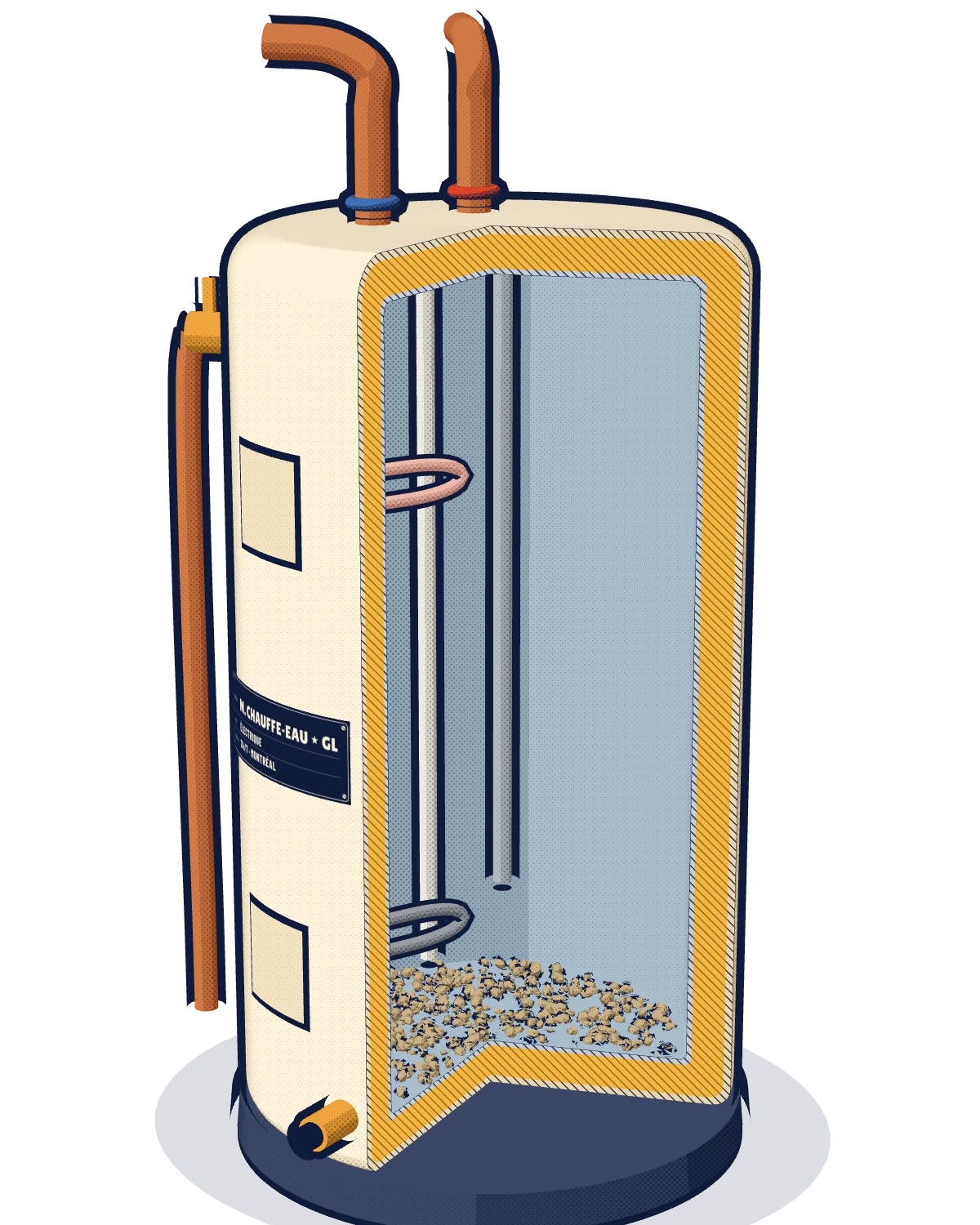 Drain valve
Is it dangerous?
A leaking hot water tank puts three things at risk: your electrical panel, your hands and your basement. In that order.
Electricity first. The tank has its own circuit, and water spreading across the floor can reach the panel. Hydro-Québec is clear: if there is water near the panel, stay away and call Hydro-Québec, which can cut the power remotely.
Burns second. Giant sets its Canadian tanks to 60°C at the factory, hot enough for a third-degree burn in six seconds, according to its manual.
Water damage last, and it grows with time. A 40 gallon tank holds about 180 litres and a 60 gallon about 280, according to Giant's brochure. A leak left to run also becomes an insurance question: The Personal, for example, does not cover damage from repeated, ongoing leaks. See Hot water tank age and home insurance in Quebec.
Three things to do right away
Power first, water second, cleanup third.
Switch off the hot water tank's breaker
At the panel, switch the tank's breaker to OFF, following the safety conditions above. Giant's manual requires it before any draining: an element that heats out of the water burns out.
Close the cold water valve
It is the valve on the cold water pipe that feeds the tank. Once it is closed, the city supply stops refilling the tank: it can only lose the water it already holds. If you cannot find it or it will not turn, close the main water shut-off for the house. In many homes with a basement, Intact says, it is where the water line enters the house or near the hot water tank.
Limit the damage, then call
Mop up, lift boxes onto blocks, take photos. Leave the relief valve and the drain valve alone. If the water damaged anything, talk to your insurer before you throw the old tank out: The Personal, for example, asks you to keep the items that caused the damage until your claims advisor tells you what to do.
Where is the water coming from?
Wipe everything dry, slide a dry paper towel under the tank and watch where the water comes back. Giant's troubleshooting guide lists the usual suspects.
The relief valve's discharge pipe
The temperature and pressure relief valve, at the top of the tank, lets water out when pressure or temperature climbs too high. Its pipe runs down to the drain. A drip can come from water pressure that is too high, hot water expanding in a closed system, a valve that is badly seated or worn, or a faulty thermostat. If it runs constantly, Giant says to have a qualified technician check the system.
The drain valve
It sits at the foot of the tank. If it drips, it is either not fully closed or faulty. Either way, the fix leaves the tank in place.
A fitting on top
The hot water pipe connects on top of the tank, and on top-entry models the cold water pipe does too. A drop running down the side ends up on the floor and looks like a leak from the bottom. It is also the first place to look when the tank leaks from the top.
An element, behind its cover
An element can leak around its gasket and soak the insulation. You see it behind the access cover, which you only open with the power off at the panel.
The tank
If everything else is dry and water keeps appearing under the tank, sometimes with rust at the base, it is the tank. Giant's manual has one remedy for that case: replace the hot water tank.
Condensation, the great pretender
A tank filled with cold water for the first time, or drained of its hot water in one go, can bead with moisture. Giant says it disappears once the water heats up. If it still drips once the tank is hot, look for a fitting.
Repair or replace?
Everything screwed onto the tank can be replaced. The tank itself cannot be repaired.
- Leaking relief valve: it gets replaced with a new valve, never a used one, Giant says. If the cause is pressure, the fix is a pressure reducing valve or an expansion tank.
- Dripping drain valve: it gets closed properly or replaced.
- Fitting or element gasket: it gets tightened, cleaned or replaced.
- Leaking tank: the whole hot water tank gets replaced.
What about the tank's age?
Several insurers ask for a hot water tank to be replaced after 10 or 12 years, even if it still works. If yours is there, check your policy before paying for a repair. See Hot water tank age and home insurance in Quebec.
When to call a professional
Right away if the water comes from the tank, if it is getting near the electrical panel, if the relief valve runs constantly or if it still leaks with the cold water closed. Same if you cannot find the source.
M. Chauffe-Eau GL is open 24/7 in Montreal, Laval, the North Shore and the South Shore. Send a photo of the leak and the rating plate, and we'll get back to you with a price in under an hour.
Sources
- Residential electric water heater owner's manual, installation and operating instructions (GI-IM017En), Giant, consulted September 27, 2026
- Residential electric water heaters, Standard, Cascade and Super Cascade, product brochure (GI-PB019En), Giant, consulted September 27, 2026
- What to do in case of water damage or flooding, Hydro-Québec, consulted September 27, 2026
- The complete guide to water damage prevention (2026 edition), published March 10, 2026, Intact Insurance, consulted September 27, 2026
- Home insurance, homeowner, The Personal, consulted September 27, 2026
- Claims: water damage, The Personal, consulted September 27, 2026
- La question de la semaine : Est-ce que votre assureur peut refuser de vous indemniser parce que votre chauffe-eau est trop vieux? (25 septembre 2017) (in French), Radio-Canada, La facture, consulted September 27, 2026
No hot water? Call M. Chauffe-Eau GL
Open 24/7, in Montreal, in Laval, on the North Shore and on the South Shore.