

Guide
How long does a hot water tank replacement take?
The short answer
It mostly depends on how easy the tank is to reach and what parts need adding. At M. Chauffe-Eau GL, plan on about an hour and a half on site. Once the new tank is full and reconnected, Giant's manual says there should be hot water at the tap after about an hour. Heating the whole tank takes longer.
The part in question
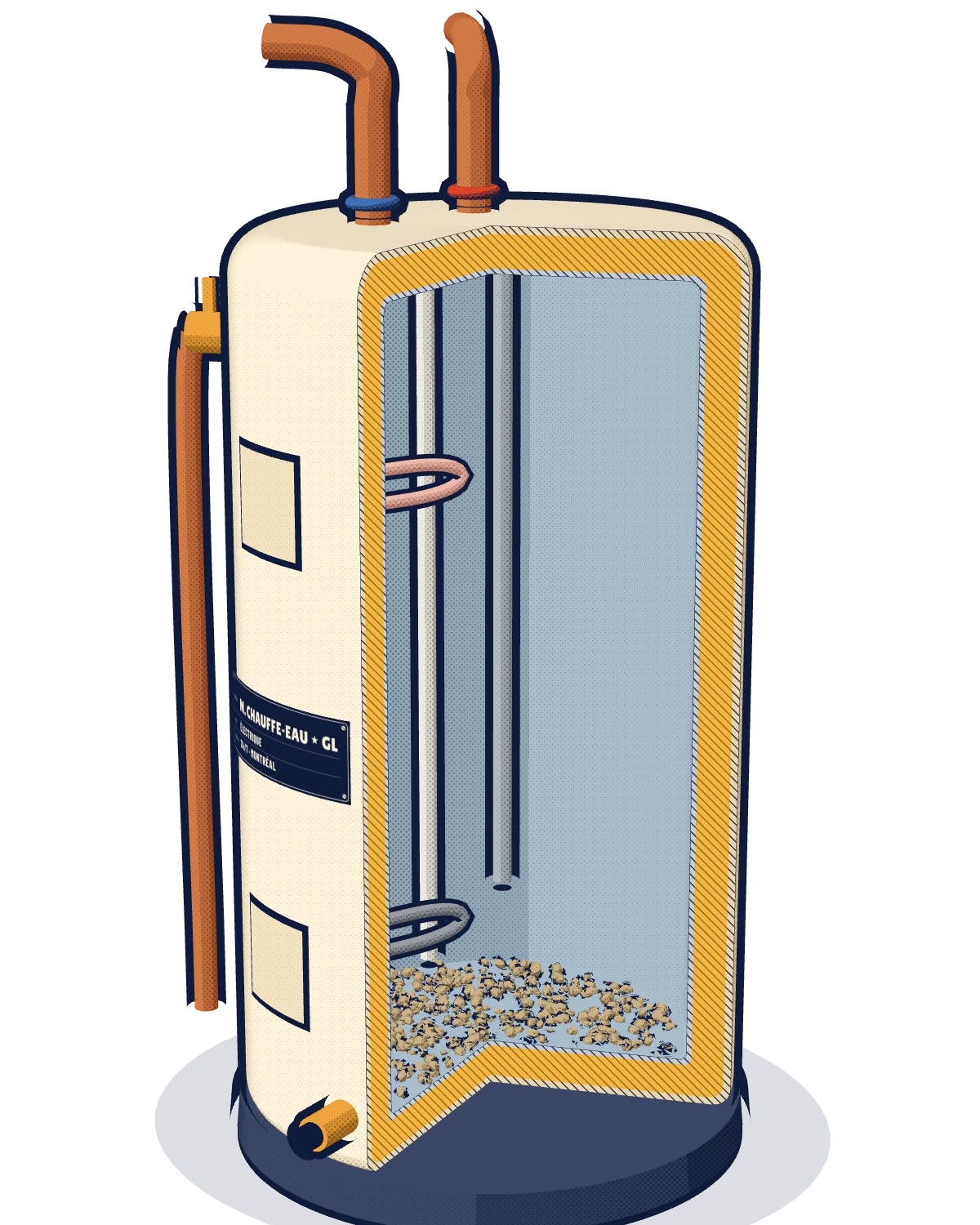 Drain valve
Installation day
A replacement follows this order. The safety instructions come from Giant's manual for residential electric hot water tanks.
Power off, then the cold water
The tank's breaker is switched off at the panel, then the cold water shut-off valve is closed. Giant is firm on this: never drain a hot water tank without cutting the power first.
Drain the old tank
A hose runs from the drain valve to the floor drain. A hot water tap in the house is then opened to let air in, and the tank empties.
Disconnect and remove the old tank
The water and the electricity are disconnected, and the old tank leaves the room. M. Chauffe-Eau GL takes it away and disposes of it, for an extra fee.
Install the new one
The new tank goes in, with a pan under it: Giant stresses how important it is to install one. The cold water, the hot water and the relief valve are connected.
Fill it before the power goes back on
The cold water is opened, then every hot water tap in the house, until the water runs without air. Giant insists: no power until the tank is full, or it can fail early.
Power on and check
The breaker is switched back on, the connections are checked, and the thermostat sits at 60°C, Giant's factory setting for Canadian models.
What can make the job longer
A few situations add work on the day:
- tight access: a narrow staircase, a crawl space, a closet the tank barely fits into;
- an expansion tank to add: Giant requires one when the plumbing has a check valve, a water meter or a pressure-reducing valve;
- a drain pan to fit where there wasn't one;
- an old tank that's rented: it belongs to the rental company (Protégez-Vous, 2024), and returning it has to be arranged with them.
Why we ask for a photo of the space around the tank
The way in and the floor often tell us as much as the rating plate. With the photo, we can see ahead of time what the day will need. Tight access takes more time and may add a charge, announced ahead of time. And preferably, someone stays home during the installation.
If the old tank is rented
M. Chauffe-Eau GL doesn't handle the return: you call the rental company yourself. Find the contract before the appointment. What to look for is in Renting vs buying a hot water tank.
How long before there's hot water
According to Giant's manual, once the breaker is back on, there should be hot water at the tap after one hour. If not, check the breaker and wait another hour. If there's still nothing, it's time to call a technician.
That's the first hot water. For a full tank, you can estimate the time with a little arithmetic and the element wattages CAA-Québec gives for each size:
40 gallon (180 litres), 3,000 W element
180 litres × 50°C × 1.163 Wh = about 10.5 kWh. Divided by 3,000 W: about 3.5 hours.
60 gallon (270 litres), 4,500 W element
270 litres × 50°C × 1.163 Wh = about 15.7 kWh. Divided by 4,500 W: about 3.5 hours.
What this math assumes
Cold water coming in at 10°C, heated to 60°C, with no heat loss. It takes 1.163 Wh to warm one litre of water by one degree. In winter the cold water comes in colder, so it takes longer. Your element's wattage is printed on the rating plate. By this math, a Giant 40 gallon (184 litres, 3,000 W) takes about 3½ hours to heat all the way, and a 60 gallon (279 litres, 4,500 W) about the same, because its element is stronger. Giant's manual says you'll already have hot water at the tap after about an hour.
Once the tank is hot
CAA-Québec gives the first-hour rating, the hot water available in one hour of heavy use: about 173 litres for a 40 gallon tank with a 3,000 W element, and 259 litres for a 60 gallon tank with a 4,500 W element.
Getting ready for the visit
Five minutes of tidying before the appointment saves everyone time.
Work order
No.
Clear the way from the door to the hot water tank, stairs included.
Make room around the tank: boxes, bikes, Christmas decorations.
Find the electrical panel and the tank's breaker.
Make sure the floor drain is reachable.
Have the contract handy if the old tank is rented.
Keep pets in another room.
If you haven't already, take a photo of the rating plate and the space around the tank.
When to call a professional
If the old tank is leaking, don't wait for a quiet day: shut off the power, close the cold water valve and call. If the water is turning lukewarm or the plate shows 10 years or more, plan the replacement before the tank plans it for you.
M. Chauffe-Eau GL replaces 40 and 60 gallon Giant electric hot water tanks, 24/7. See hot water tank replacement, or send a photo of the rating plate and the space around it: you'll have a price in under an hour.
Sources
- Chauffe-eau résidentiels électriques : manuel du propriétaire, guide d'installation et d'utilisation (GI-IM017Fr, in French, 2023), Usines Giant, consulted September 27, 2026
- Chauffe-eau : quelle capacité choisir pour votre maison? (in French, updated June 29, 2026), CAA-Québec, consulted September 27, 2026
- Location d'appareils ménagers à long terme : quels sont vos droits? (in French, October 22, 2024), Protégez-Vous, consulted September 27, 2026
No hot water? Call M. Chauffe-Eau GL
Open 24/7, in Montreal, in Laval, on the North Shore and on the South Shore.